
⏰ The Final Countdown: Latest Interview Format Revealed!
Latest Interview Format Released & Reminder About Our Last Minute Interview Top Tips Webinar!

Ahhhhhhhhhhhhhhhh!
It’s finally sinking in. Your interview is now only a few days away.
Breathe…relax…it’ll be A-okay.
If we could summarise how you’re feeling while waiting for that link to go live, this GIF would be the one:
For those of you painstakingly checking your inbox, the Recruitment Panel officially released the interview format yesterday. If you’ve been feeling like you’re preparing in the dark, consider this your floodlight.
We’ve put on our detective hats and broken down what we think those 30 minutes will look like so you can practice with surgical precision.
⏱️ The Breakdown: 30 Minutes to Glory
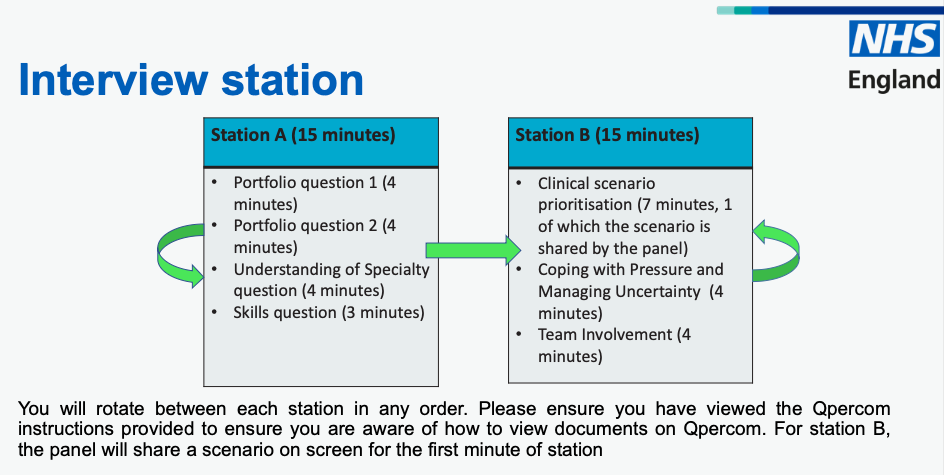
The interview consists of two 15-minute stations. You can be funnelled into either Station A or Station B first, so be ready to hit the ground running regardless of the starting point.
Station A (15 Minutes)
This station is all about your track record, your understanding of the specialty and if you have the skills to pay the bills. It’s your chance to prove that your portfolio isn’t just a piece of paper, but a roadmap to having all the necessary characteristics to be a future Clinical Radiologist.
Portfolio Questions 1 & 2 (4 mins each): This year’s format makes us feel old. Back in our day, the panel poked through your physical folder. For you young whippersnappers, this is a fresh dynamic. We expect open-ended questions linked to your achievement domains. “What commitment have you shown to the specialty?” or “What did you learn from your taster week?”. Be warned, we think the panel will also use this time to clarify your portfolio score if there are any discrepancies between what you claimed and the evidence they see. Pro Tip: Know your self-score, your evidence, and the scoring matrix inside out.
Understanding of Specialty (4 mins): From the classic “Why Radiology”? to testing your knowledge on the challenges facing the field e.g. artificial intelligence, this is where you prove to the interviewers that you know the specialty inside out. Make sure you have not only read around these common areas, including the workforce crisis, but can link it to your own personal experiences e.g. taster weeks.
Skills Question (3 mins): You can talk the talk but can you walk the walk? This is where the interviewers will determine if you can showcase the skills required for a career in Radiology. Remember, always link it back to your own personal development of that skill and experiences of that skill within the world of Radiology. If in doubt, use the “RadCast Litmus Test” (trademark pending) -Radiology and Psychiatry are polar opposites on the medical spectrum. If you can take your answer, swap the specialty names, and it still makes sense in a Psychiatry interview, it is far too generic. Your skills should feel like they belong in a reporting room, not on a therapy couch.
Station B (15 Minutes)
For us, this is the most difficult component of the entire process. It’s designed to test your clinical acumen and your ability to navigate through scenarios that are intentionally murky and often quite confusing.
Clinical Scenario Prioritisation (7 mins): This is the “big” one and it’s a high-stakes gatekeeper.
The Benchmarking Red Line: You need to score a minimum of 6/10 here for benchmarking purposes. This station can truly be “make or break” for your application.
The Golden Minute: The panel will share a scenario on screen for the first minute; we’ve had clarification that the clinical prioritisation scenario will be shared for 1 minute at the start of the station, but will be left on screen for the duration of the question. Use that 60 seconds to breathe and map out your ranking and thought process. Make sure to look out for any key details e.g. suggesting a pregnancy test for the woman of childbearing age.
The Rationale: You’ll then have 6 minutes to explain your thinking. Don’t just list the order; explain the why.
Coping with Pressure & Managing Uncertainty (4 mins): Radiology is a high-stakes game of “maybe.” In this section, they will give you a scenario and ask you to navigate the nuances of a difficult situation. Above all, they are looking for a safe and ethical doctor. When the clinical picture is murky, follow your frameworks. * Whether you are dealing with a difficult colleague, a resource shortage, or a diagnostic dilemma, ensure that patient safety is never compromised. If you can demonstrate that you know your limits and when to escalate, you’ve already won half the battle.
Team Involvement (4 mins): Contrary to popular belief, Radiology is not a solo sport. They want to see how you’ve developed the skillset to work within an MDT. Have good and bad examples of teamwork ready. Be prepared to highlight how you’ve grown from these scenarios and crucially, how you can link those lessons back to a career in Radiology.
Reminder: Access Our Top Tips On Mastering The ST1 Radiology 2025–26 Interview
Knowing the format is only 20% of the battle. The other 80% is how you articulate your answers under the gaze of a panel. If you missed it, we recently dropped a massive resource to help you navigate this period. This isn’t a substitute for a 1-to-1 mock. Nothing replaces personalised feedback tailored to your delivery and answers.
But it is structured, strategic support.
What We Covered
🎯 The “Gold Standard” Framework
How to structure Clinical Prioritisation & Ethics answers under pressure.
📂 Portfolio Intelligence
Our strategy on how to approach the portfolio related questions that were newly introduced this year.
🏛️ High-Scoring Systems
Repeatable templates for specialty-specific and skills-based stations.
You can access the webinar recording using the button below:
A Final Word From Us At RadCast
We know the nerves are kicking in, but remember: you’ve done the hard work to get this far. Whether you’re refining your portfolio narrative or drilling clinical prioritisation, you’ve got the toolkit to succeed.
It has been an absolute pleasure meeting so many of you through our mock 1-to-1 interview sessions over the last few weeks. Your energy, questions and dedication to the specialty have thoroughly impressed us all and reminds us why we love doing what we do at RadCast.
From all of us here, we wish you the very best of luck. Take a deep breath, watch the clock and show that panel why you belong in the reporting room.
As always, feel free to reach out to us via hello@radcast.co.uk if you have any questions.
Till next time,
From your “please rank the following scenarios from most to least urgent” friends,
- Team RadCast 🩻 (written by a non-artificial, non-intelligent and fasting MK at 10:02 GMT on the 21st February 2026)